Russian Civilian Casualties and Ukrainian Strikes: Sources
Contents
The Ukraine Files · Companion to Part 7 of 8
By William Aaron Turner, President of Infinitum Corporation · The Ukraine Files: Full Series
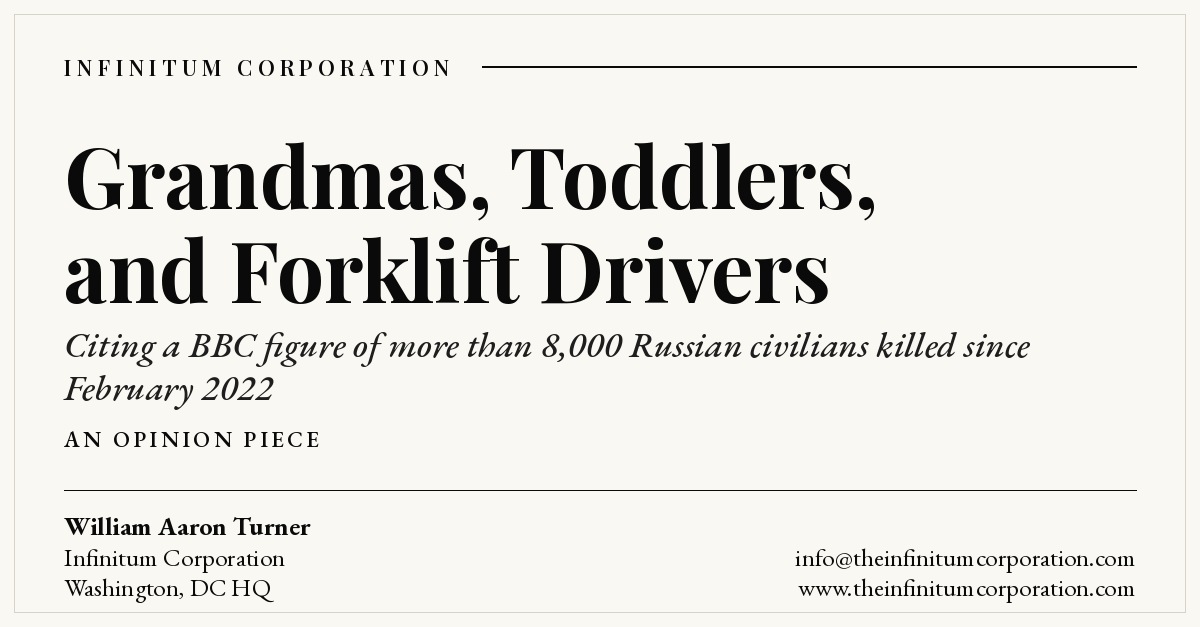
"Since February 2022, more than 8,000 Russian civilians have been killed in Ukrainian strikes (BBC, 2026)." That is the figure my X Article Grandmas, Toddlers, and Forklift Drivers is built around. I state at the start of the article that it is an opinion piece and not a balanced report. This post is the standalone version: the cases the article describes, the source named for each figure, what Ukraine says in response, and where I argue the reasoning fails. A shorter summary of this article also appears inside Part 7 of the series, which combines it with The Kidnapping of a Nation.
Read the full original X Article →
Grandmas, Toddlers, and Forklift Drivers, on X
Key takeaways
- The headline figure is more than 8,000 Russian civilians killed since February 2022, attributed in the article to BBC (2026). I did not independently verify it, and the number is only as strong as that source.
- The article walks through three recent cases: the Wildberries warehouse strikes in July and August 2026 (9 to 13 employees killed, per AP, 2026), the August 3, 2026 beach incident in Arkhipo-Osipovka (7 killed, including 3 children, 40 wounded, per BBC, 2026) and the August 10, 2026 TANECO refinery strike in Nizhnekamsk (13 killed, including 1 child, 39 injured, per ABC, 2026 and ABP Live, 2026).
- For the border regions, the article cites BBC (2026) for 224 civilians killed and 1,500 injured in July 2026 alone in Belgorod and adjacent areas.
- Ukrainian officials, as quoted by the BBC (2026), say Ukraine does not deliberately target civilians, that the warehouses supplied the Russian military, and that some deaths are the "accidental result of air defences shooting down incoming missiles and drones." Moscow denies the military-supply claim.
- The arguments about "dual-use" targets, a double standard and Western silence are my position, labeled as such below. They are not findings of any court or UN body.
Want the whole argument? This post covers the outline and the sourcing. The original X Article has the full text.
Part 1: The figure and how I use it
The article opens with the BBC (2026) figure of more than 8,000 Russian civilians killed in Ukrainian strikes since February 2022, and returns to it in the conclusion. I frame the piece as "all data from the public record, all conclusions mine." I also say plainly that the article is not neutral, which is why this post separates what a named outlet reported from what I conclude.
Part 2: The Wildberries warehouse strikes
Wildberries is Russia's largest online retailer and is often compared to Amazon. According to AP (2026), Ukraine struck between 12 and 23 Wildberries facilities across Russia over about a month, from Elektrostal near Moscow to Yekaterinburg, more than 2,000 kilometers from the Ukrainian border. The article reports that Ukraine's Defence Ministry said seven of the ten largest Wildberries logistics centers were taken out of operation (BBC, 2026), and that one-fifth of the company's warehouse space, 1.18 million square meters, was destroyed.
The casualties, as listed
- July 18, 2026, Elektrostal (Moscow Oblast) and Kotovsk (Tambov Oblast): 8 night-shift workers killed in Kotovsk, and 1 more died later from injuries in Elektrostal. Dozens were hospitalized with burns and shrapnel wounds (AP, 2026).
- July 22, 2026, Krasnodar and Nevinnomyssk: 1 young woman killed and at least 14 to 15 injured (Gazeta Express, 2026).
- Through mid-August 2026: further strikes near St. Petersburg, Simferopol, Ryazan, Yekaterinburg, Voronezh, Tula and Vladimir, and on the large Koledino facility near Moscow (Gazeta Express, 2026).
The total given in the article is 9 to 13 employees killed, with dozens wounded (AP, 2026). The BBC (2026) is quoted saying that Kyiv maintains the Wildberries depots are used to supply the Russian military, which Moscow denies, and that the platform sold military-related goods such as body armour until recently, alongside items with both civilian and drone-production uses. AP (2026) is quoted describing the targets as "warehouses that bring the convenience of online shopping across the breadth of Russia," as opposed to refineries, ports or arms plants. In its analysis, The Conversation (2026) describes the campaign as "bringing the war home to consumers."
Part 3: Arkhipo-Osipovka beach, August 3, 2026
Per the BBC (2026), a drone crashed onto a beach in Arkhipo-Osipovka, a Black Sea resort in the Krasnodar region. Social media footage verified by the BBC showed the drone hurtling toward a cliffside and crashing in a fireball on the beach below. The BBC reports 7 people killed, 3 of them children, and 40 injured, 17 of them hospitalized with severe burns, fractures and shrapnel wounds.
- Competing explanations: some Ukrainian Telegram channels claimed electronic warfare jammed the drone's signal and caused the crash. Eyewitnesses quoted by Russian media said gunfire came before the explosion, which suggests air defences may have tried to shoot it down (BBC, 2026).
- No claim of responsibility: Ukraine did not claim the strike (BBC, 2026).
- Russian position: regional governor Veniamin Kondratyev called it "a deliberate strike on civilians" (BBC, 2026).
- Witnesses: tourists and residents told local outlets no sirens sounded before the attack, and one holidaymaker said, "We covered ourselves with sun loungers, and didn't see where it exploded" (BBC, 2026).
The article does not claim to know who launched the drone or why it came down there. My point is narrower: when a drone from this war lands on a crowded beach, "air defences were involved" does not answer the question of what the drone was doing in that sky.
Part 4: TANECO refinery, Nizhnekamsk, August 10, 2026
Ukraine's military confirmed it hit Tatneft's TANECO refinery in Nizhnekamsk, Tatarstan, about 800 kilometers east of Moscow, and said a fire was recorded at the facility (ABC, 2026). The article reports 13 people killed, including 1 child, and 39 injured, many with severe burns (ABP Live, 2026). Several of the dead were Central Asian workers, from Uzbekistan and Tajikistan, staying in a hostel near the industrial site. Russian investigators opened a criminal case, saying Ukraine struck residential areas and that a child was among the civilians killed (ABC, 2026). Tatarstan head Rustam Minnikhanov declared a period of mourning (ABP Live, 2026).
ABC (2026) is cited for the refinery's scale: 17 million tons of crude processed in 2024, producing 2.7 million tons of gasoline and 8.5 million tons of diesel, and for the fact that it was also hit in early June. Ukraine says it wants to bring the price of the war home to ordinary Russians (ABC, 2026). I do not dispute that a refinery that produces fuel is a different kind of target from a warehouse. My argument is about what happens to the people next to it.
Part 5: The border regions
For Belgorod, Kursk and Bryansk, the article describes near-constant cross-border drone, artillery and missile fire since 2022, affecting homes, vehicles, playgrounds and commercial sites. The figures it cites:
- 224 civilians killed and 1,500 injured in July 2026 alone in Belgorod and adjacent areas (BBC, 2026).
- August 17, 2026: six people killed and four injured in Ukrainian missile strikes on Belgorod region overnight, with a 14-year-old among the injured. A woman was killed in an attack on a civilian bus in Belgorod, and an 83-year-old man died in a drone attack in the Moscow region (BBC, 2026).
- Early August 2026: a playground in Printsevka was hit, with one child killed and two injured, per the article.
- FPV drones and shelling in villages such as Oktyabrsky, Shebekino and Grayvoron producing a steady stream of civilian deaths and injuries (BBC, 2026).
I argue that a campaign of this size is not a series of accidents. That is my reading, not a finding of the BBC, which reports the casualties and the officials' statements.
Part 6: What Ukraine says, and where I disagree
As quoted by the BBC (2026), Ukrainian officials say the logistics hubs supply the Russian military with drone components, navigation equipment and other dual-use gear. They also say Ukraine does not deliberately target civilians and that some deaths in Russia are the "accidental result of air defences shooting down incoming missiles and drones." Those statements belong in the record, and I include them in the article.
My reasoning against them, labeled as argument:
- The "dual-use" standard. I argue that if the test is "this platform sells items the military could use," almost any large retailer qualifies. In the article I compare it to treating Amazon or a hardware store as a military target. A standard that wide, I say, removes the protection civilian commercial sites are supposed to have.
- The "air defence" explanation. I argue that blaming the defender for the debris does not answer why the drone was launched toward that area to begin with. I compare it in the article to throwing a brick at a house and blaming the occupant for trying to catch it.
- The Russian position. The article records Moscow's position that these are civilian commercial facilities and that strikes on them are terrorism against ordinary workers.
Part 7: The double-standard argument
The longest argument in the article is about response. I argue that Russian strikes on commercial buildings and playgrounds in Ukraine are rightly condemned as war crimes or terrorism, while comparable deaths in Russia are described as "tragic accidents" tied to "air defence intercepts" (BBC, 2026) or as "degrading the enemy's logistics." I also argue that the UN, the ICC and Western governments have said far less about the Russian deaths. The article does not cite a source for that comparison of reactions, so please treat it as my position and judge it against what you read elsewhere.
My conclusion in this part: the Geneva Conventions do not apply selectively, and if killing civilians is wrong it is wrong whichever side's drone does it. I also note in the article that war is ugly and mistakes happen, and I argue that the pattern here goes beyond mistakes.
My conclusion
I write the original article to argue that civilian deaths in Russia are being under-reported and under-condemned in the West, and I close it with a list of the dead as I read them: the Wildberries workers, the people on the beach, the hostel residents in Nizhnekamsk, the border-region victims and the 8,000 counted by the BBC (2026). You do not have to agree with my framing. If you do not, I would ask you to check each figure against the named source and to compare how each side's civilian deaths are discussed. For the mobilization claims and the Ukrainian side of the human cost, see Part 7: Ukraine's Forced Mobilization. For the economic context, see Russia's economy under sanctions.
Sources named in the article
- ABC News (2026, August 10), on the Nizhnekamsk strike
- ABP Live (2026, August 10), on the Nizhnekamsk casualties
- AP News (2026, August 17), on the Wildberries campaign
- BBC News (2026, August 17), on the Belgorod and Moscow region strikes
- BBC News (2026, August 3), on the Arkhipo-Osipovka beach
- Gazeta Express (2026, August 17), on the Wildberries strikes
- The Conversation (2026, August 14), on Russia's missile investment and the warehouse campaign
Full reference entries are in the original X Article.
Read the original X Article:
- Grandmas, Toddlers, and Forklift Drivers (https://x.com/i/article/2089708406206586880)
Follow @infinitumceo on X for every new file in the series.
Join us on Telegram: https://t.me/infinitumcorporation
Explore the rest: The Ukraine Files: Full Series · About the author · Take the Global Political Survey
← Previous: Forced Mobilization & the Kidnapping of a Nation | Next: Sweeps, Spies, and the Connections → | All files in the series
Comments (0)
Add a comment